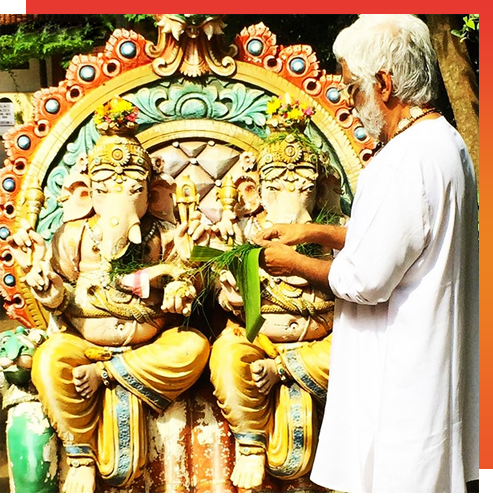
Ganesha or Vighneshwara is the Lord of Obstacles of material and spiritual order and His dharma is to remove obstacles and to place obstacles in the path of those who need to be checked. He could be considered as the most endearing form of all Hindu deities and His birthday; Ganesha Chaturthi, which falls on the fourth day of the bright fortnight of Bhadrapada, is celebrated with great devotion and delight. This year Ganesha Chaturthi falls on September 1st.
Ganesha Purana considers Ganesha to be one of the unrefined forms of the ultimate Brahman. One can find His shrine immediately after the entrance in any temple complex. This symbolizes His importance as a guard or protector. He is such a simple deity that one can make a Ganesha idol with clay, mud or even cow dung as done in some parts of India like Tamilnadu. Being a secondary God not elevated to the highest level like Lord Shiva or Lord Vishnu. He is very close to the human beings and the advantage is that the Elephant God understands human problems better than the High Gods like Shiva and Vishnu.
Humans can relate to Him so easily and get their desires fulfilled. He rules over the Muladhara Chakra, the lowest or primal energy centre in Human body that controls our sense of stability and security in this life. Lord Ganesha, being closest to the material plane of consciousness, is the most capable to assist us in our day-to- day life concerns. He helps us to get our footing, stand our ground and find our strengths. He is easily contactable and is called Kshipra prasadhi - one who blesses instantly.
Significance of Ganesh Chathurthi lies in the way in which people attach themselves with all their devotion and faith to the care and pampering of the all-embracing Lord Ganesha also loving called Lord Vinayaka. It is believed that Lord Ganesha remains on the earth plane on Vinayaka Chaturthi or Vinayaka Chavithi to bestow His presence on all his devotees.
On Ganesh Chaturthi, people worship the Astavinayakas referred to the eight embodiments of Lord Ganesha that abolished the negative powers of the evil elements that existed in this world. The belief that adds the significance of Ganesh Chathurthi is that "Lord Ganesha always comes to abolish the negative forms in every period and every age".
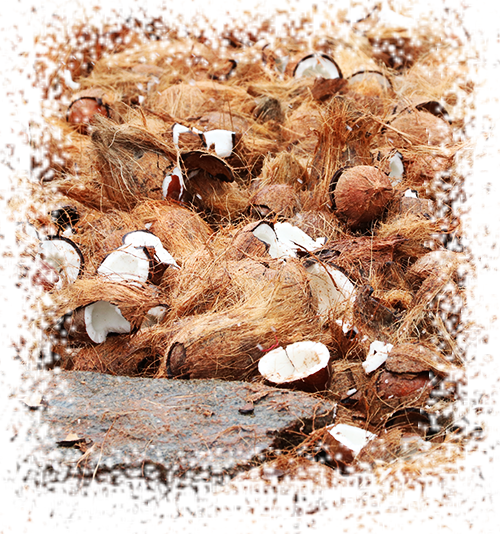
Shattering coconuts on Ganesha Chaturthi helps you to remove your negative influences as this is considered as a spiritual technology that manifests in both your material and spiritual worlds. The coconut energetically absorbs your lower vibrations and when it is smashed, the energy holding back your progress is forcefully disseminated.
The Kridakhanda of the Ganesha Puranas narrates the stories of four incarnation of Ganesha in the four different Yugas.
According to Sri Chandrasekara Saraswathy Swamigal - the former Sankaracharya of Kanchi mutt, Ganesha reinvents Himself and incarnates in every Yuga according to the thought patterns of the Humans that prevail during that specific epoch. Swamigal declared that in this kali yuga, it is the Naramuga Ganesha that is going to be powerful, because He is the Ganesha for this age.
Dr. Pillai, the renowned spiritual scientist has remarked "We sacrificed 2 truckloads of coconut to Naramuga Ganesha who is in the small shrine of the Temple in Thilatharpanapuri in TN, India. AstroVed employed about 20 people to break the coconut. As a result, the temple that was in a small shrine of 6 ft by 6ft space and was unnoticed so far, became so popular that, now a big temple is being constructed. It is all because of the worship we do. Ganesha has become more powerful and a big temple is been constructed. Therefore with the rituals you empower the God and as the God gets empowered He empowers you."
The Power of Ganesha is the primordial energy of whole cosmos and it gets multiplied on Ganesha Chaturthi. Lord Ganesha lifts our consciousness to the next chakra, uniting us with our inner guru, thus reaching the third eye where the root source as Ganapathy that is symbolized by the Root Chakra, the Muladhara.
Ganesha was the only deity who even dared to fight Lord Shiva. He is a fearless deity who removes fear.
Muladhara Chakra represents both the extremes of the fear factor. When it is slow, the person feels highly insecure while when it is in high speed the person is prone to take extreme risks. Ganesha balances this Chakra. He stimulates intelligence, enhances your problem solving skills, stabilizes your emotions, removes obstacles and hand holds you to success.
Since the Elephant God, Lord Ganesha is the incarnation of the collective qualities inevitable to make a human happy and successful, he is always ready to give it to anyone who asks Him for it. He bestows His blessings equally on fools as well as intellectuals.
Also, since Muladhara represents the element Earth; hence worshipping Clay Ganesha helps you to access his blessings and to remove your Karma. The sense organ that Muladhara represents is nose and the sense is smell. They are special features of Ganesha, the only deity with an elephant head. With His trunk he urges us to probe into things.
Gain the blessings of Lord Ganesha with Clay Ganesha, which is a very special offering to make during Ganesha's birthday. Clay Ganesha can absorb your karma just like coconuts, and when dissolved in the ocean will dissolve your karma as well.
Lord Ganesha, who is famous for his wisdom, sense of humor holds a Pasha in one of His right hand to attract the minds of his devotees, to propel mankind forward on the eternal path and to remove obstacles from the way of his devotees, while the other hand bestows boons. One of the left hands that carry an Ankusha, symbolizes the demolishment of ignorance and a gentle execution to capture all the difficulties, while the hand that holds a lotus or a rosary, suggests that the quest for knowledge should not quench.
The cosmic belly of Ganesha contains the seven worlds above and the seven worlds below with their seven oceans held together by the cosmic energy kundalini symbolized as a huge snake which Ganesha ties around him. Kundalini represents the unification of the feminine Shakthi energy and the masculine Shiva consciousness through the Ida and Pingala Nadis, which when aroused gets united and passes through the Sushumna Nadi which marks the enlightenment.
Lord Ganesha's head symbolizes the soul, which is the eventual and supreme reality of human existence. His body signifies Maya and His trunk represents "OM". His ears can hear all our prayers and the snake that runs around his waist, represents energy in all forms. He uses a mouse (represents anger, pride, selfishness etc) to ride, which indicates us to have a control on all these evil passions. And finally the "laddoo" that he holds in his trunk, signifies that one must discover the sweetness of the soul.
Ganesha is a primordial God who has evolved and transformed over space and time. The Mudgala Purana, an ancient text on Lord Ganesha, cites eight forms of Lord Ganesha, prevailing over eight human weaknesses or demons. They are:-
Lord Ganesha is also depicted in 16 different forms namely Bala, Taruna, Bhakta, Veera, Shakti, Dwija, Siddhi, Ucchishta, Vighna, Kshipra, Herambha, Lakshmi, Maha, Vijaya, Nritta and Urddhva Ganapatis.
These 16 Ganeshas were later logically associated with the various thithis or lunar days starting from Amavasya (New Moon day). On this day, the Bala Ganesha (Child Ganesha) was propitiated. On the next day, when the moon is seen as a very thin crescent and is visible for a very short time in the sky, He is called Taruna Ganesha, and so on and so forth. There is a hym called Ganapati Shodasa Nama Stotram (this hymn praises the 16 names of Ganesha) in the 24th Prakarana of Upasana Khanda of Ganesa Purana.